As the climate crisis worsens, disasters are becoming more extreme and upending countless lives around the globe. The American Red Cross is on the frontlines of this humanitarian crisis and is making $1.1 billion in strategic investments to ensure we can be there to help those with no place else to go.
Brad Houle's Commitment
This past year, Brad Houle, a prominent member of the Red Cross Cascades regional board, joined other forward-thinking donors as a member of the Legacy Society. Brad works as a financial consultant to individuals, nonprofits, and foundations at a capital management firm, so he knows how essential the services that the American Red Cross provides are to the people who need them most. Beyond that, his tax-wise and savvy monetary management expertise is why he chose to generously support the Red Cross through a beneficiary designation.
A beneficiary designation is one of the simplest ways to make a gift to the Red Cross. It is as easy as filling out a form. You can specify the individuals and charities you want to support, and you can also specify the percentage of the assets you want each beneficiary to receive. Beneficiary designations are available when giving the following assets: retirement assets, life insurance, commercial annuity contracts, bank and investment accounts.
Brad explained, “The reason I chose a beneficiary designation instead of making a gift to the Red Cross in my other estate planning documents, is that it is quite easy to go in and change the beneficiary on your IRA and leave a percentage to the organization. I manage money for a living. I thought it was a complicated process, but when I got down to it, it only took around seven minutes.”
As vice chair of the board of directors, he campaigns to raise money in the Oregon Cascades Region, and he leads by example. “If this is something that you’re going to ask of others and you’re going to advocate for others to do, you have to do it yourself.” Inspired by altruistic acts at an early age, the Red Cross has always been a part of Brad’s life as his mother worked as a Blood Services employee in Montana. When considering what he wanted to support at the Red Cross, he chose to leave his gift undesignated, or where needed most. “The less you put strings on the money the better it is for the organization. If you trust this organization enough to leave them money or a legacy gift, then I am going to trust them to do whatever they think is right with the money.”
If you would like information about how you can support our mission and help those in need by creating your own legacy like Brad Houle and others have done, please contact our Gift Planning Office at, 1-800-797-8022,ext. 5,giftplanning@redcross.org.
Life Insurance–Flexibility for You
Life insurance provides financial security for your heirs in case of an untimely death. However, your financial needs may diminish over time as your children grow and become financially independent and you transition to retirement. If so, your life insurance policy could allow you to make a generous contribution to the American Red Cross at little or no cost to you and might even provide tax savings too.
You might consider a gift of your life insurance policy if:
Your life insurance policy is paid up or has substantial cash value.
Your family is provided for by other means.
You would like to make a generous gift to the Red Cross.
There are two different ways to contribute to your life insurance policy. One provides greater tax benefits, the other preserves more flexibility for you.
Option One: Give your Policy to Red Cross
You can contribute by transferring ownership of your policy to the Red Cross. Once the Red Cross is owner of the policy, we will cash in the policy and use the proceeds immediately to support our life-saving programs and services. In addition, you can enjoy an income tax deduction for the current value of the policy if you itemize.
Option Two: Make Red Cross the Beneficiary of Your Policy
Simply request a beneficiary change form from your insurance company and add the Red Cross as the beneficiary of the policy. You can name Red Cross to receive a portion of the proceeds–large or small, whatever works best for you–or the entire amount (sole beneficiary). This option preserves flexibility for you because you retain ownership of the policy and you can alter your gift if your circumstances change.
Life insurance has been an important part of your financial security. Now it can provide a simple way to make a gift to support the Red Cross and prevent and alleviate human suffering wherever it may be found.
We would be happy to provide further information on how a gift of life insurance could work for you. We encourage you to consult your own legal, tax, and financial advisors before deciding on a course of action.
Everyone’s circumstances are different, and we stand ready to work with you and your advisors to craft a gift plan that fits your needs.
If you would like information about how you can support our mission and help those in need by creating your own legacy, please contact our Gift Planning Office at, 1-800-797-8022,ext. 5,giftplanning@redcross.org.
Make a Gift & Receive Income for Life
Do you have an asset, maybe securities or real estate, that you would consider contributing to the American Red Cross, but you need the income the property provides? Or perhaps you have an asset from which you would like to receive more income, but you hesitate to sell it because capital gain taxes would take a big bite out of the proceeds. If so, consider contributing your asset to a charitable remainder unitrust.
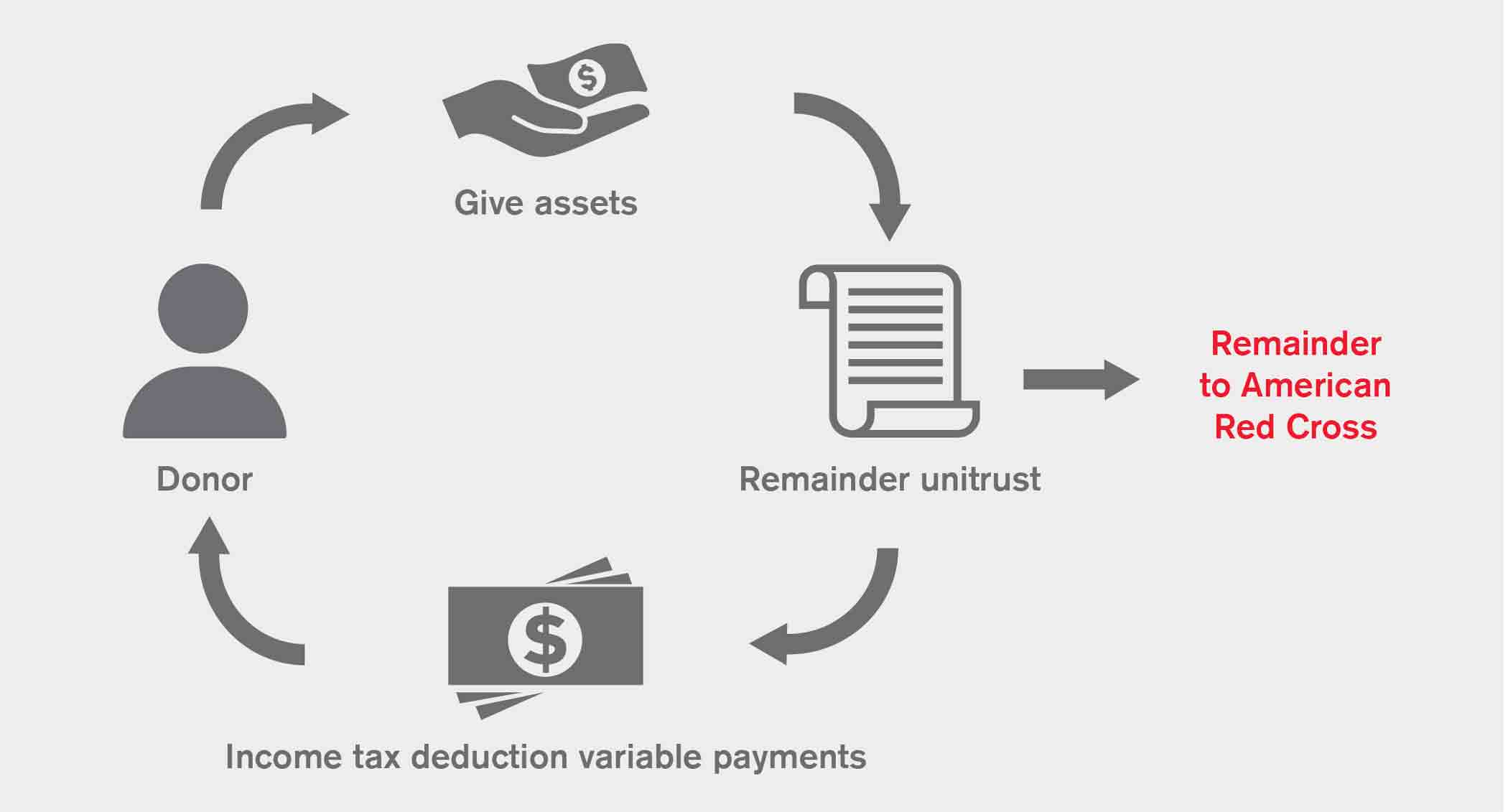
A charitable remainder unitrust allows you to make a generous gift to the Red Cross and receive a lifetime of income at the same time. A remarkable advantage of a charitable remainder unitrust is the trust is tax exempt there is no capital gains tax when the trust receives your appreciated assets or when it sells them. This allows your trust to put the full value of your assets to work first for you and ultimately for the Red Cross. In addition, you receive an income tax charitable deduction for a portion of your contribution which can reduce your income taxes now.
How a charitable remainder unitrust works
You transfer assets to a trust and choose a trustee (i.e., American Red Cross, your advisor) to oversee the operation of your trust.
You choose the income beneficiaries of your trust, which could be you, you and your spouse, loved ones, or anyone else you wish.
Your trustee manages the trust assets and pays a fixed percentage of the trust fund to your beneficiaries annually. The amount of the payments will vary with the value of the trust fund each year.
When the trust ends, usually upon the passing of the last income beneficiary, the remaining assets go to the Red Cross.
We would be happy to provide further information and illustrations showing how a charitable remainder unitrust could work for you. We encourage you to consult your own legal, tax, and financial advisors before deciding on a course of action. Everyone’s circumstances are different, and we stand ready to work with you and your advisors to craft a gift plan that fits your needs.
For more information on giving through any of the tax wise options above, contact the Gift Planning Office at 1-800-797-8022,ext. 5,giftplanning@redcross.org.
Staying in touch via the American Red Cross email list is the best way we have of keeping in regular contact with supporters like you, letting you know about how you can protect yourself and your loved ones from disasters and other emergencies, and how you can support our life-saving work.
Click here to unsubscribe from our list, but please know that if you leave, it will be harder for you to stay involved with the Red Cross and continue the work of which you’ve been such a critical part. It is only because of supporters like you that the Red Cross is able to respond when a disaster strikes or a home is impacted by fire, when someone needs CPR or a lifesaving blood transfusion, or when a family needs to contact a deployed service member in an emergency. And we don’t want to lose you! Thanks for your support!